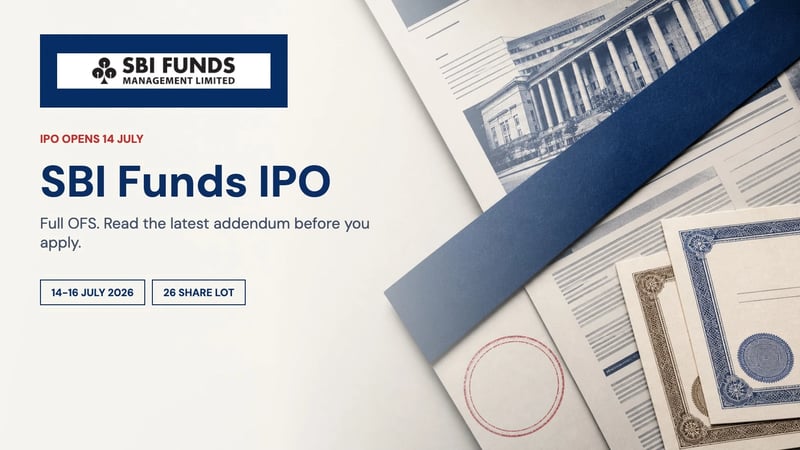
The SBI Funds Management IPO closed on 16 July 2026 at a final issue price of Rs 574 per share. It was subscribed 41.66 times and listed on 21 July at Rs 613.30 on NSE and Rs 610 on BSE. The shares ended their debut session at Rs 609.75 on NSE and Rs 609.90 on BSE.
The offer is over, so this is no longer an application guide. The useful lesson remains the offer structure: this IPO was a full offer for sale, or OFS. The company raised no fresh money through the public issue because existing shareholders sold part of their holdings.
Updated 27 July 2026: This article was revised after listing to replace application-stage guidance with the final issue price, subscription, listing prices, debut close, and completed-offer context.
What the filing and listing showed
- The final offer was up to 17.10 crore shares after a pre-IPO transaction reduced the original RHP size.
- The offer was entirely an OFS, so the sale proceeds went to the selling shareholders after offer expenses.
- A mutual fund business can be familiar without its IPO price automatically being attractive.
- Read the latest addendum with the RHP because the offer changed after the RHP was filed.
- An SBI Mutual Fund investment is not the same as owning SBI shares for the shareholder reservation.
- Strong subscription did not make the unofficial grey-market estimate a reliable listing-price forecast.
SBI Funds Management IPO details at a glance
| Detail | Current information |
|---|---|
| Bid period | 14 July to 16 July 2026 |
| Price band | Rs 545 to Rs 574 per share |
| Minimum bid lot | 26 shares and multiples of 26 |
| Minimum amount at upper band | Rs 14,924 |
| Final issue price | Rs 574 per share |
| Final subscription | 41.66 times overall |
| Final offer size | Up to 170,956,631 shares, or about 17.10 crore shares |
| Offer structure | 100% offer for sale |
| Selling shareholders | State Bank of India and Amundi India Holding |
| Fresh issue | None |
| Listing exchanges | BSE and NSE |
| Listing date | 21 July 2026 |
| Listing price | Rs 613.30 on NSE; Rs 610 on BSE |
| Debut close | Rs 609.75 on NSE; Rs 609.90 on BSE |
The current share count is lower than the 203,709,239 shares shown in the original RHP. A pre-IPO sale took place after that filing, and SEBI published an addendum on 13 July. This is exactly why an IPO reader should check the latest filing, not stop at the first number found in an older article.
1. What does a full OFS mean for you?
Imagine that a shop has two owners. One owner sells part of his stake to the public, but the money does not go into the shop’s cash counter. It goes to the owner who sold the stake.
That is the simple effect of an offer for sale.
In this IPO, SBI Funds Management is not issuing fresh shares to raise new capital. State Bank of India and Amundi India Holding are selling existing shares. The company expects the benefits of listing, but it will not receive the OFS proceeds.
An OFS is not automatically good or bad. It changes the question you should ask.
With a fresh issue, you would check how the company plans to use the new money. With a full OFS, you should focus more closely on:
- why the existing shareholders are reducing their holdings
- how much ownership they retain after the offer
- the business’s growth without fresh IPO capital
- whether the price makes sense compared with earnings and listed peers
Do not treat the word “OFS” as a warning by itself. Treat it as a reason to read the offer structure correctly.
2. What was the price band and lot size?
State Bank of India’s exchange disclosure set the price band at Rs 545 to Rs 574 for each share with a face value of Rs 1. It also fixed the minimum bid at 26 shares, followed by multiples of 26. The final issue price was Rs 574.
For a retail application at the upper end:
26 shares x Rs 574 = Rs 14,924

Official pre-offer price-band advertisement, captured from the public advertisement hosted by Axis Capital on 14 July 2026. The final issue price was Rs 574. The SBI Funds offer documents remain the primary source for the completed offer.
During bidding, banks blocked the application amount under ASBA. A successful application did not guarantee allotment, and allotment did not guarantee a listing gain.
If you have never applied before, read Paisaseed’s walkthrough on how to apply for an IPO online before approving a UPI mandate. Check the company name, amount and mandate expiry instead of approving a request only because it arrived during IPO week.
3. Why did the offer size change after the RHP?
The original RHP described an offer of up to 20.37 crore shares. A pre-IPO sale was completed before public bidding, and the latest offer was reduced to about 17.10 crore shares.
That does not make the RHP useless. The RHP still contains the business, financials, risks and detailed offer information. The addendum updates the parts that changed.
Use them together:
- Open the SEBI RHP filing.
- Open the 13 July addendum.
- Check the latest public notice or exchange disclosure before submitting the bid.
Our DRHP and RHP guide explains what can change between filing stages and which document matters when the offer opens.
4. Are SBI Mutual Fund units enough for the shareholder quota?
No. Holding units of an SBI Mutual Fund scheme does not make you a shareholder of State Bank of India.
The RHP provides a reservation for eligible SBI shareholders. Eligibility follows the offer document’s definition and the relevant record date. The holding needs to be in State Bank of India equity shares, not merely an investment in an SBI Mutual Fund scheme, an SBI bank account or an SBI insurance policy.
If you believe you are eligible, verify these before choosing the shareholder category:
- SBI shares were held in the relevant demat account on the stated date
- PAN details match the IPO application and demat account
- the application category is selected correctly
- your bid follows the limits and conditions in the latest offer document
Do not select a reserved category because an app displays it as an option. A wrong category can create an avoidable application problem.
5. What business are you actually buying into?
SBI Funds Management runs the investment-management business associated with SBI Mutual Fund. Its income is linked to the assets it manages and the fees earned across its products and mandates.
The name is familiar, but the listed company will not be the same thing as one of its mutual fund schemes. You would be buying shares in the asset-management company, not units that track a fund’s portfolio.
When reading the filing, check:
- assets under management and the mix across equity, debt, passive and other products
- how revenue and profit changed across the reported years
- dependence on the SBI distribution network and brand
- market share and whether growth is concentrated in a few product types
- operating costs, employee expenses and fee pressure
- related-party arrangements with promoters and group entities
A large asset base sounds impressive. What matters to a shareholder is how the business earns from that base, how durable those earnings are and what price the IPO asks you to pay for them.
6. Which risks deserve more than a quick glance?
Start with the RHP’s Risk Factors section. Do not read only a summary shared by a broker or social-media account.
For an asset manager, useful questions include:
- Can market falls reduce assets under management and fee income?
- How dependent is the company on the SBI name and distribution reach?
- Could regulation or fee changes affect revenue?
- Is investment performance concentrated in certain schemes or periods?
- How does the business handle operational, technology and compliance risk?
- What happens if investors move from higher-fee products to lower-fee passive products?
These are not predictions that something will go wrong. They show what can affect the company’s future earnings after the excitement of listing week is over.
7. Does the valuation leave room for mistakes?
The price band tells you the cost of one share. It does not tell you whether the share is cheap or expensive.
Compare the upper-band valuation with the company’s latest profit, earnings per share and listed asset-management peers. Then ask whether differences in market share, growth, profit margin and business mix justify a higher or lower multiple.
Be careful with grey market premium chatter. It can change quickly, it is not part of the official offer document, and it does not explain the value of the business. A popular IPO can list below its offer price. A weak subscription headline can also fail to describe the company’s long-term quality.
The better question is not, “Will this list at a profit?” It is, “Would I still understand why I own this business if the first trading day is disappointing?”
Seven checks to carry into the next IPO
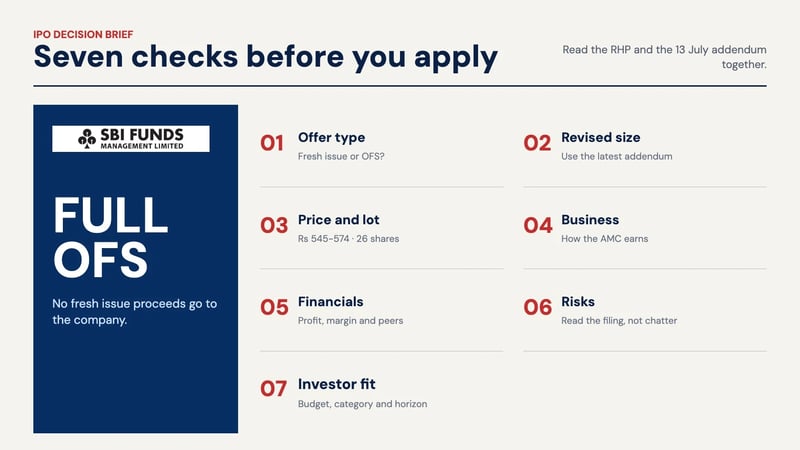
The completed offer leaves a reusable filing checklist:
- You are reading the latest offer terms, including the addendum.
- The category is correct for your actual eligibility.
- The bid quantity is a multiple of 26.
- The blocked amount fits your budget without touching emergency money.
- You understand that this is a full OFS.
- You read the financial and risk sections, not only the brand name.
- Your decision does not depend on a guaranteed allotment or listing gain.
You can follow more filing-led coverage in Paisaseed’s Business & Companies guides. The aim is to make the document easier to read, not to replace your own investment decision.
Bottom line
The SBI Funds Management IPO closed on 16 July 2026 and listed on 21 July. The final issue price was Rs 574 per share. NSE listed the shares at Rs 613.30 and BSE at Rs 610, while the debut closes were Rs 609.75 and Rs 609.90 respectively.
The most important filing fact remains that the issue was a full OFS. Existing shareholders received the sale proceeds, while the company gained a listing but no fresh IPO capital. The 41.66-times subscription and positive debut do not change how the structure should be read or turn past performance into a future return signal.
This article is for education and historical offer research. It is not a recommendation to buy, sell or hold the listed shares. Market prices can move above or below the issue price. Read current exchange disclosures and consider a SEBI-registered investment adviser for personal advice.
FAQs
What is the SBI Funds Management IPO price band?
The price band was Rs 545 to Rs 574 per share, and the final issue price was Rs 574.
What is the minimum investment in the SBI Funds Management IPO?
The minimum lot was 26 shares. At the final price of Rs 574, one retail lot required Rs 14,924 to be blocked through ASBA.
Is the SBI Funds Management IPO a fresh issue or an OFS?
It is a full offer for sale. State Bank of India and Amundi India Holding are selling existing shares, and the company will not receive fresh capital from the OFS proceeds.
Do SBI Mutual Fund investors qualify for the shareholder quota?
SBI Mutual Fund units alone do not make you an SBI shareholder. Eligibility depends on holding State Bank of India equity shares under the conditions stated in the offer document.
Why is the current IPO size lower than the original RHP size?
A pre-IPO sale took place after the original RHP was filed. SEBI published an addendum, and the current public offer was reduced from up to 20.37 crore shares to about 17.10 crore shares.
Did applying at the cut-off price guarantee allotment or listing profit?
No. A cut-off bid could remain eligible for price discovery, but allotment depended on demand and allocation rules. A successful allotment did not guarantee a listing gain.