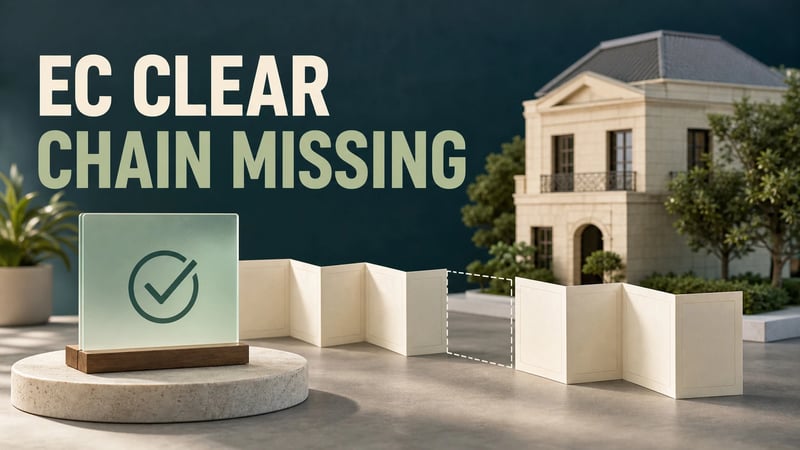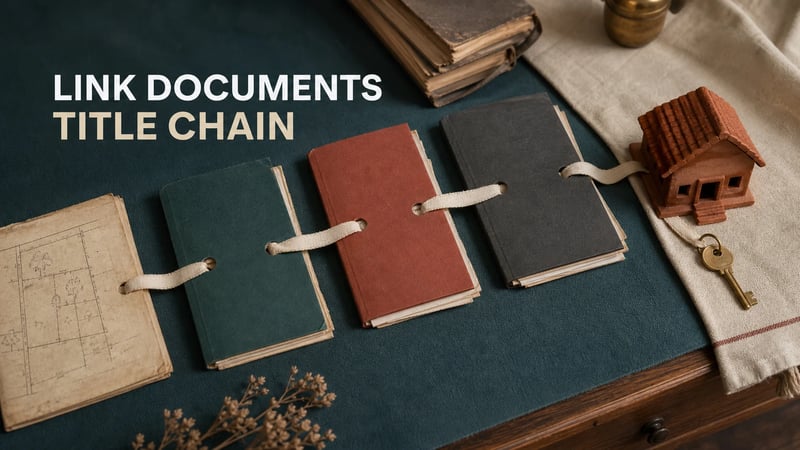
A sale deed, mother deed, link documents and encumbrance certificate are not four names for the same property paper.
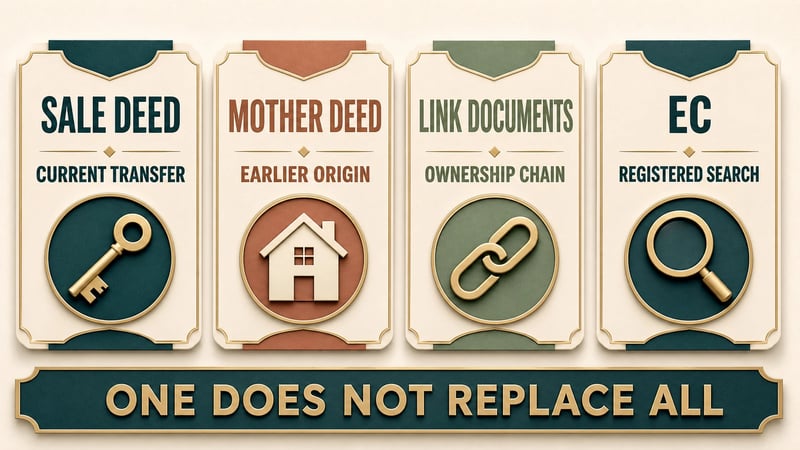
The sale deed records a transfer. The mother deed usually points to an older origin document. Link documents connect the ownership chain. The EC reports registered transactions or charges returned for the property details and period searched.
Key takeaways
>
– A current sale deed does not automatically show the full earlier title. – “Mother deed” is commonly used property language, but the exact document depends on the title history. – Link documents are a set of connecting records, not one standard certificate. – An EC is a registered-record search, not a replacement for the deeds. – Banks may ask for all of them because each answers a different question.
The simplest rule is this: one paper should not be forced to prove everything.
The four documents at a glance
| Record | What it usually shows | Main question | What it does not prove alone |
|---|---|---|---|
| Sale deed | A registered sale between named parties for a described property | How did this buyer acquire through sale? | The entire earlier title and every approval |
| Mother or parent deed | An older or origin document in the title history | Where does this chain begin or branch from? | Every later transfer |
| Link documents | Connected title instruments across earlier owners | Does each ownership step connect? | That no other legal or approval issue exists |
| EC | Registered transactions or charges returned for searched details and period | What registered entries appear in the search? | Full title, possession, approvals or unregistered issues |
The labels can vary across states, lenders and legal offices. Focus on the role, date, parties and property description.
What is a sale deed?
A sale deed is the registered instrument through which a seller transfers the described property to a buyer for the stated consideration and terms.
In a resale transaction, the current seller’s sale deed usually shows:
- seller and buyer names from that earlier sale
- property description
- sale consideration and terms
- document number and registration details
- rights and interests stated to be transferred
- signatures and registration endorsements
When you buy, a new sale deed is executed for the transfer from the present seller to you.
The seller’s existing deed is therefore important. But it starts with the person who sold to your seller. You may still need to ask how that earlier person obtained title.
That is where the chain enters.
What is a mother deed?
“Mother deed” or “parent deed” is a commonly used label for an older document from which the later title chain is traced.
It is not always one specific type of deed.
Depending on the property, people may use the term for:
- an old sale or conveyance deed
- an authority allotment or grant
- a partition instrument
- a landowner’s title before development
- an earlier document that created separate plots or shares
The oldest paper in the seller’s folder is not automatically the correct origin document. A qualified local property lawyer decides how far the title should be traced and which record serves as the relevant starting point.
Ask: Why is this being called the mother deed, and which later documents flow from it?
What are link documents?
Link documents are the records connecting one ownership stage to the next.
A chain might look like:
authority allotment → sale deed → partition deed → release deed → seller’s sale deed
Another might look like:
landowner title → development agreement → builder conveyance → flat sale deed
The chain does not need to contain only sale deeds. It needs a documented explanation for each change.
For Telangana readers, the term has official local use. The state’s BuildNow checklist lists sale deed and link documents under ownership documents for parts of its process.
That state checklist is not a bank-approval rule. It confirms the terminology. The lender still applies its own legal and technical standards.
What is an encumbrance certificate?
An encumbrance certificate, or EC, is obtained for specified property details and a specified period. It reports the registered transactions or charges returned by that search.
Depending on the record, entries may help identify:
- a sale
- gift or other registered transfer
- registered mortgage
- release or cancellation
- document number, year and parties
The EC is useful for checking whether the physical document file and registration trail appear consistent.
But it is not the property’s complete biography.
It does not automatically establish:
- that every deed in the chain is available
- that the search particulars were correct
- that no family or succession dispute exists
- that the building follows its sanctioned plan
- that taxes and society dues are cleared
- that the seller has a marketable title
- that a lender will approve the property
Treat it as an important search result, not a one-page safety certificate.
Where do mutation, tax and municipal records fit?
These records can support the property file, but do not casually relabel them as sale deeds or link deeds.
A mutation or municipal entry may help show whose name appears in a revenue, tax or local-body record. A property-tax receipt may show that tax was paid under a particular name. A society share certificate or no-dues letter may support the apartment file.
They still answer narrower administrative or payment questions.
| Record | Useful check | Do not assume |
|---|---|---|
| Mutation or revenue entry | Name and land-record status | It replaces the registered title instruments |
| Property-tax receipt | Tax account and payment | The payer alone has complete title |
| Society or association record | Membership, unit and dues | Every earlier ownership and approval issue is cleared |
Compare them with the deeds. Do not use them to explain away a broken transfer chain.
A worked property-chain example
Suppose a house has this history:
- An authority allotted the plot to Meera in 1998.
- Meera sold it to Ravi in 2006.
- Ravi gifted it to his daughter Ananya in 2018.
- Ananya wants to sell it to you in 2026.
The documents may play these roles:
| Role | Possible record |
|---|---|
| Origin or mother document | Authority allotment or conveyance to Meera |
| First link | Registered sale deed from Meera to Ravi |
| Second link | Registered gift deed from Ravi to Ananya |
| Current seller’s title | Gift deed plus connected earlier chain |
| Your transfer | New sale deed from Ananya to you |
| EC | Registered search entries corresponding to the relevant transactions and period |
If the 2006 sale deed is missing, the gift deed may show Ravi as donor but the file does not explain how Ravi became owner.
A clean-looking latest deed does not remove that question.
Can the EC replace a missing mother deed?
No automatic replacement exists.
The EC may identify the older registered transaction and help locate its document number. A certified copy from the registration authority may reproduce the registered record if it is available.
Whether that addresses the lender’s query depends on:
- which document is missing
- whether the original is required
- whether the certified copy matches the later chain
- whether title or only custody is in question
- lender policy
- independent legal review
Do not accept the sentence “EC is clear, so mother deed is not needed” without understanding the actual file.
Which documents does the bank usually ask for?
For a resale home, a lender may ask for:
- current title deed
- previous title or link documents
- agreement to sell
- initial payment receipts
- EC
- sanctioned plans and approvals
- occupancy or completion records where applicable
- tax and society records
- existing-loan closure information
The public list is normally indicative. The legal and technical teams can request additional property-specific records.
Your financial eligibility remains separate from this document review. A good income profile does not turn an incomplete title chain into acceptable security.
Five mistakes to avoid
Mistake 1: Calling every old deed the mother deed
Ask which title function the document performs instead of accepting the label.
Mistake 2: Treating the latest sale deed as the full chain
It shows one transfer. Read its earlier-document references.
Mistake 3: Treating a clear EC as a legal opinion
Check the search details, period and document chain separately.
Mistake 4: Assuming revenue or tax records are title deeds
They can support the file, but their role differs from a registered transfer instrument.
Mistake 5: Asking the bank to protect every buyer interest
The bank reviews the property for lending and mortgage purposes. Use your own qualified local property lawyer for the buyer’s title and agreement review.
A simple document-review order
- Read the current seller’s title document.
- List every earlier document it refers to.
- Arrange all link records by date.
- Identify the origin or mother document used for the chain.
- Compare the EC with the deeds.
- Check names, survey numbers, area and boundaries.
- Review approvals, dues and existing mortgages separately.
- Share the complete file with the lender.
- Obtain an independent title review before a large payment.
When discussing the file, use exact descriptions: “2011 registered gift deed unavailable” is better than “mother document issue.”
Bottom line
The sale deed records a sale, the mother deed usually points to an older title origin, link documents connect ownership changes and the EC reports registered entries found in a search.
They work together. None is a universal substitute for the others.
For the financing side, browse Paisaseed’s Loans & EMI Planning guides. For the title, ask a qualified local property lawyer to review the actual records and state-specific requirements.
This article is educational and not legal, lending or property-purchase advice. Document terminology and title requirements vary by state, property history and lender. Verify current official records and obtain advice from a qualified local property lawyer and proposed lender.
FAQs
Is a sale deed the same as a title deed?
A sale deed is a title instrument recording a sale. “Title deed” is often used more broadly for documents supporting ownership. The exact title file may include more than the latest sale deed.
Is the mother deed compulsory for a home loan?
The lender may ask for an origin or previous-chain document depending on the property history. The relevant record may not always be called a mother deed.
Can link documents include a gift or partition deed?
Yes. A link is defined by the ownership connection it explains, not by whether it is a sale. Gift, partition, release, allotment and other records may form the chain.
Is an EC proof of ownership?
It is a registered-record search for specified property details and a period. It should not be treated as a standalone substitute for the title instruments and legal review.
Which document should I check first?
Start with the current seller’s title document. Read its references, then work backwards through the earlier chain and compare those records with the EC.