Yes, a property with only one registered sale deed may still qualify for a home loan. But the number one does not decide the answer.
The lender will want to know why there is only one deed and which documents explain the title before that deed. A first sale from a builder is very different from an old resale property whose earlier deeds cannot be found.
Key takeaways
>
– “Single registration property” is buyer language, not one standard legal category. – One sale deed may be normal in a genuine first transfer. – A resale property with an unexplained missing chain is a different risk. – The lender may ask for allotment, land-title, development, gift, inheritance or other origin records. – Loan approval depends on the property’s facts and lender policy, not only the count of registered sale deeds.
Start by asking one question: How did the seller obtain title?
What does “single registration property” usually mean?
People use this phrase for several situations:
- the flat is being sold by the builder for the first time
- an authority allotted or conveyed the property to the current owner
- the property came through a gift or inheritance
- an old family property was registered only recently
- the seller has one deed but cannot produce earlier documents
- the buyer has seen only one deed, though more records exist
These are not legally or practically identical.
Do not let one informal phrase collapse them into the same answer.
Why does only one registered sale deed exist?
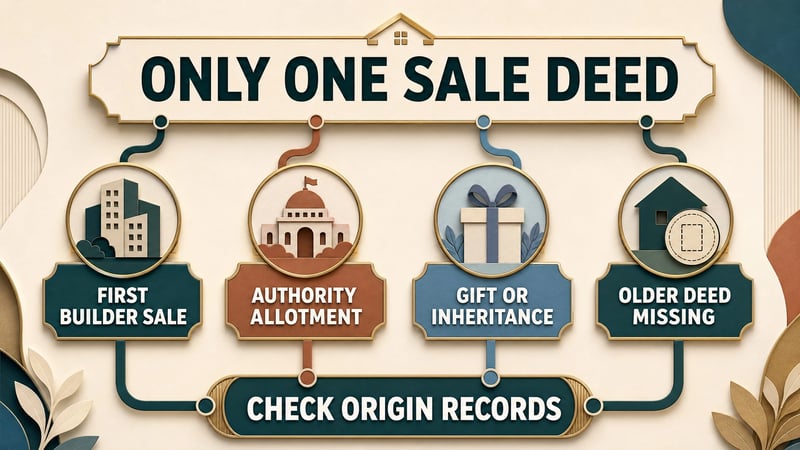
The reason usually falls into one of four groups.
It is the first sale of a newly built flat
If you buy directly from a builder, there may be no earlier sale deed for your individual flat.
That can be normal. But the lender may still examine the underlying land title, development agreement, power of attorney where applicable, sanctioned plan, project approvals, allotment or buyer agreement and the document through which the flat will be conveyed to you.
The flat may be new. The land title is older.
The property began with an authority allotment
A development authority, housing board or government body may have allotted the property to the current holder. The file may rely on an allotment letter, possession record, lease-cum-sale document, conveyance deed or other authority record instead of a previous private sale deed.
The exact record depends on the scheme and tenure.
The seller received it by gift, partition or inheritance
A sale deed is only one way title can move.
The current seller may hold:
- a gift deed
- partition deed
- release or relinquishment deed
- succession-related records
- a will and any supporting court or family documents applicable to the case
- mutation or municipal entries supporting, but not necessarily creating, the claimed ownership
In that situation, the lender may inspect the earlier owner’s title plus the later event that brought the property to the seller.
An earlier ownership document is actually missing
This is the case buyers worry about.
The seller’s current deed refers to a previous owner, but the file does not show how that previous owner acquired the property. Or the EC shows an earlier registered transaction that is absent from the seller’s papers.
That is not a harmless “single registration” feature. It is a title-chain question that needs document recovery and legal review.
Count ownership steps, not sale deeds
Imagine three properties, each with one sale deed in the seller’s file.
| Property | Why there is one sale deed | What else may be needed |
|---|---|---|
| New builder flat | First sale of the unit | Land chain, development rights, approvals, buyer agreement and conveyance |
| Authority-allotted plot | Current owner received the first allotment or conveyance | Allotment, possession, lease or conveyance and compliance records |
| Twenty-year-old resale house | Earlier deeds are unavailable | Certified copies, EC trail, origin records and legal explanation of the gap |
The paper count is the same. The document risk is not.
This is the most useful way to discuss the file with the lender.
Is one sale deed enough for the bank?
Sometimes the bank may accept a one-deed file supported by other title and approval records. Sometimes it will not clear the property until further documents are supplied.
A current lender checklist for resale homes can ask for title deeds including the previous chain of property documents. The lender’s legal team may also request property-specific records after reading the file.
Approval depends on questions such as:
- Can the seller’s title be traced to a documented origin?
- Does the property description stay consistent?
- Are all owners and heirs accounted for?
- Are required approvals available?
- Does an existing mortgage or charge need closure?
- Can the lender create the mortgage it requires?
- Does the property fit the lender’s internal policy?
No article can answer these from the phrase “one registration” alone.
Sanction for you is not clearance for the property
A lender can assess your income and issue an in-principle or conditional sanction before the property file has fully cleared.
There are separate questions:
| Question | Main review |
|---|---|
| Can you afford the EMI? | Credit and income assessment |
| Is the property acceptable security? | Legal, technical, valuation and policy assessment |
| Can money be released now? | Disbursement conditions and original-document handover |
Paisaseed’s loan-eligibility calculator estimates the first question. It cannot answer the second.
Ask the lender whether the property legal and technical clearance has finished, not only whether your loan amount was sanctioned.
Documents to ask for in each one-deed situation
Use the reason for the one deed to build the request.
First sale from a builder
Ask about:
- landowner’s title chain
- development agreement and authority, where applicable
- sanctioned plan and layout approval
- project registration and declared approvals where applicable
- allotment or builder-buyer agreement
- occupancy or completion records where applicable
- final sale or conveyance deed process
Authority allotment
Ask about:
- original allotment
- possession record
- lease conditions, if leasehold
- conveyance or freehold conversion, if applicable
- transfer permission or restriction
- dues and compliance certificates required by that authority
Gift, partition or inheritance
Ask about:
- previous owner’s title
- instrument or event through which title moved
- all affected co-owners or legal heirs
- registration and court records required for that case
- mutation, tax and possession records that should align
Missing older deed
Ask for:
- current and earlier EC search
- document number, year and Sub-Registrar Office
- registered-document details
- available photocopy or reference in a later deed
- certified copy from the registration authority
- written lender response on what it will accept
- independent lawyer’s title review
Do not accept “the bank will manage” as a document.
What should match across the file?
One deed can look neat while the supporting records describe a slightly different property.
Compare:
- seller and earlier-owner names
- survey and subdivision numbers
- plot, flat and municipal numbers
- area and boundaries
- undivided share of land
- development or authority details
- dates and document references
- co-owner and heir details
A difference is not automatically fraud. It is a question that needs a documented answer before registration and disbursement.
Red flags that deserve a pause
Slow down if:
- the seller refuses to share origin records
- the deed mentions an earlier document that nobody can locate
- the EC shows a transaction missing from the file
- names, survey numbers, area or boundaries do not align
- one heir or co-owner is excluded without explanation
- the seller says bank approval makes independent review unnecessary
- a large non-refundable token is demanded before document review
- the builder’s flat deed is available but the land title is not
The pause is not a final legal verdict. It creates time to understand the property before your money becomes the next problem.
A practical pre-application sequence
- Ask the seller what “single registration” means in this file.
- Write the title-origin story in one paragraph.
- List every supporting document for that story.
- Compare the EC and registered-document details with the physical file.
- Share the complete file with the proposed lender.
- Ask what remains pending in legal and technical verification.
- Obtain an independent title review from a qualified local property lawyer.
- Commit money only under reviewed written terms.
Keep the lender’s document requests in writing. If the bank rejects or conditions the file, ask which property issue triggered the decision and whether it can be resolved.
Bottom line
A property can have one registered sale deed and still have a documentable title. This often happens in a first builder sale, authority allotment, gift or inheritance.
But one deed can also hide a missing earlier chain. The safe answer comes from the title’s origin, supporting records, property description and lender review, not the number of papers in the folder.
Use Paisaseed’s Loans & EMI Planning guides for the borrowing side. Use a qualified local property lawyer for the title and transaction.
This article is educational and not legal, lending or property-purchase advice. Title records, authority documents and lender policies differ by property, state and transaction. Verify current official records and obtain advice from a qualified local property lawyer and proposed lender.
FAQs
Can SBI, HDFC Bank or another lender approve a property with one sale deed?
Any lender may ask for supporting title, approval and origin records before deciding. Approval is property-specific and policy-specific, so a result from one property or lender does not guarantee another.
Is a first-registration flat the same as a property with no link documents?
Not necessarily. A first sale of the flat may have no earlier flat sale deed, but the lender can still examine the land title, development rights and project approvals.
Can an EC prove that one sale deed is enough?
No. An EC is one record search. It does not decide whether all title instruments, ownership events and approvals needed for that property are complete.
What if the previous sale deed is lost?
Identify the registered document through the EC, later deed or registration records and ask about a certified copy. The lender and reviewing lawyer must decide whether the recovered record addresses the gap.
Should I pay token money before the one-deed file is checked?
It is safer to collect and review the property file first. If money is paid, the agreement and document-related refund conditions should be reviewed by a qualified local property lawyer.