The bank asks for “link documents,” but the seller says the latest sale deed should be enough. Who is right?
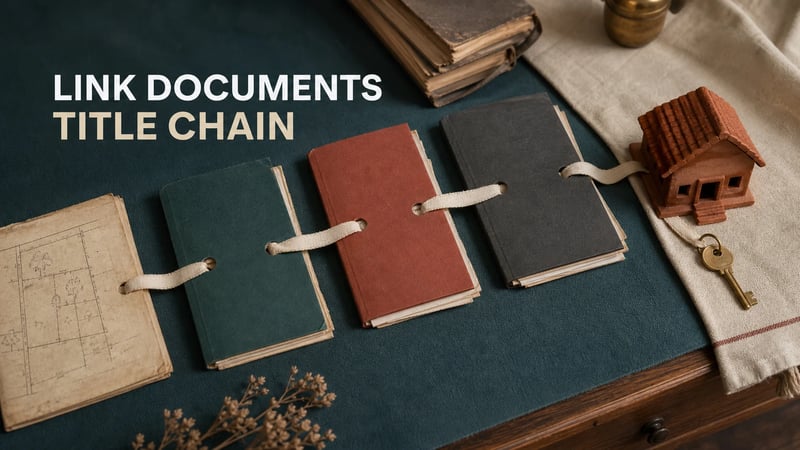
Link documents are the records that connect the property’s earlier ownership to the current owner’s title. They help the lender and its lawyer follow how the property moved from one person or entity to the next before it reaches you.
Key takeaways
>
– Link documents are the property’s ownership chain, not one special certificate. – A chain can contain sale, gift, partition, release, conveyance or allotment documents. – The latest sale deed and the EC do not automatically replace the earlier chain. – A missing original, a missing registered transaction and a genuine first transfer are different cases. – The lender decides what it accepts for its mortgage; the buyer still needs an independent title review.
The term is especially common in Telangana and Andhra Pradesh. Telangana’s BuildNow checklist uses sale deed and link documents when it lists ownership documents.
Link documents in simple words
Think of the current owner’s sale deed as the last page of a story.
It tells you who transferred the property to the present owner. But the lender may also want to know how the previous owner obtained it, and how the owner before that obtained it.
Those connecting records are commonly called:
- link documents
- chain documents
- chain of title
- previous title deeds
- parent documents
- prior sale deeds
These expressions are related, but local lawyers and lenders may not use them in exactly the same way.
There is no universal document named “Link Document” that every owner downloads. The phrase describes the function of the papers: they link one stage of ownership to the next.
A simple title-chain example
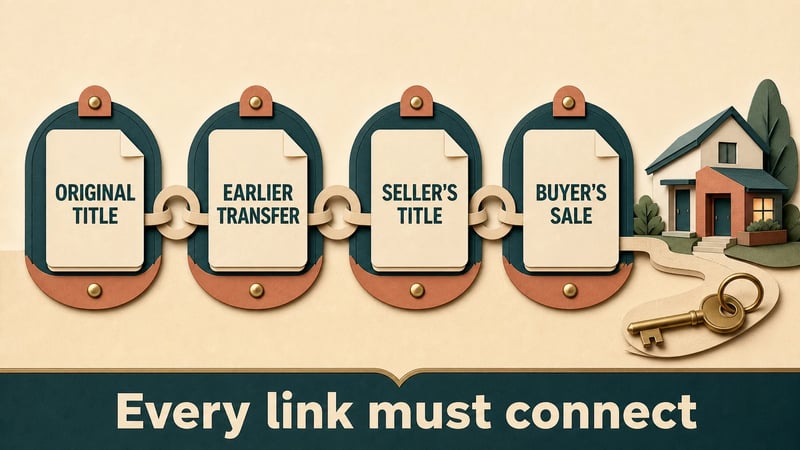
Suppose a plot changed hands like this:
- A development authority allotted the plot to Person A.
- Person A sold it to Person B through a registered sale deed.
- Person B gifted it to her daughter through a registered gift deed.
- The daughter is now selling it to you.
The chain is not four sale deeds. It may be:
allotment or conveyance document → sale deed → gift deed → your sale deed
Each step should identify the same property and explain how the next owner received rights from the previous one.
Now change one fact. If Person B’s sale deed is missing from the file, the daughter’s gift deed may still name Person B, but the file does not show how Person B became owner.
That is a document gap worth stopping for.
Which papers can form a link?
The title history decides the answer.
| How ownership changed | Document that may form part of the chain |
|---|---|
| Purchase | Registered sale or conveyance deed |
| Family gift | Registered gift deed |
| Co-owners divided rights | Partition deed or court order, depending on the case |
| One co-owner gave up a share | Release or relinquishment deed |
| Inheritance | Death, succession, will, probate, legal-heir or mutation-related records as applicable |
| Government or authority allotment | Allotment, lease-cum-sale or conveyance records |
| Builder development | Land-title chain, development agreement, power of attorney and buyer conveyance as applicable |
This is why copying a generic “last 30 years of sale deeds” list can mislead you. Some properties did not change hands through sale every time.
Ask the better question: Which document explains each ownership change?
Why does the bank ask for the earlier chain?
A home-loan lender usually expects to create a mortgage over the property. Before it accepts the property as security, its legal team checks whether the borrower’s or seller’s title can be supported under the lender’s policy.
The chain can help the lender examine:
- whether the current seller’s title connects to an earlier owner
- whether the property description stays consistent
- whether all required owners or parties appear
- whether a prior mortgage or claim needs attention
- whether an earlier transfer raises a document query
- whether the lender can obtain the security it expects
That does not mean the bank certifies the property for every possible buyer concern. Its review is part of its own lending decision.
Your income eligibility is separate. Paisaseed’s loan-eligibility calculator can estimate repayment capacity, but it cannot verify the title chain.
Sale deed, link document and mother deed are not identical
People often use these terms loosely.
| Term | Practical meaning |
|---|---|
| Current sale deed | The registered instrument through which the present owner bought the property |
| Link documents | The connected records showing earlier ownership transfers |
| Mother or parent deed | A term often used for an older or origin document in the title history |
| Encumbrance certificate | A record search showing registered transactions or charges returned for the property details and period searched |
The same old deed could be called a parent document in one conversation and a link document in another. Do not fight over the label.
Instead, create a timeline with the date, document type, transferor, transferee, document number and property description for every step.
If the timeline breaks, ask why.
Are link documents needed for a newly built flat?
A first sale from a builder may mean there is no earlier sale deed for that individual flat.
But “first sale of the flat” does not mean “no earlier property history.”
The lender may examine the title to the underlying land, the development arrangement, approved plans, project or authority records, the builder-buyer agreement, allotment and the final conveyance structure.
So a new flat can have only one eventual sale deed in your name while still requiring a substantial land and project document file.
This distinction matters when a seller says, “There are no link documents because the flat is new.” The flat may be new. The land is not.
What if the property genuinely has only one registered deed?
Do not assume that one deed is automatically defective. First identify how the title began.
| Situation | What to establish |
|---|---|
| First allotment by an authority | Allotment, possession and conveyance or lease records |
| First sale by a builder | Land title, development authority, approvals and buyer conveyance |
| Inherited property | Deceased owner’s title plus succession records applicable to the case |
| Gifted property | Donor’s title plus the gift deed |
| Old family holding | Origin, partition, succession and revenue or municipal records relevant to the title |
| Seller simply cannot find older deeds | Whether certified copies and the full transaction trail can be recovered |
One registered sale deed can be legitimate in one file and a warning sign in another. The reason decides.
Does a clear EC remove the need for link documents?
No. They answer different questions.
An EC helps review registered transactions or charges returned for the search particulars and period. Link documents provide the actual instruments and wording through which ownership moved.
The EC may help you locate an older document number. It may also reveal that the file is missing a transaction shown in the record.
But a result described as clear does not create a missing original, explain a name mismatch, validate a building approval or replace a lawyer’s title work.
Use the EC as one part of the file, not a final certificate that everything is safe.
What to do when a link document is missing
First classify the problem.
The original is missing, but the transaction is identifiable
Use the EC, registered-document details, an old copy or another official reference to identify the document number, year and Sub-Registrar Office. Ask whether a certified copy can be obtained.
In Telangana, Bhu Bharati lists Registered Document Details, Encumbrance Fetch and Certified Copy of Document among its services.
Whether the lender accepts a certified copy in that case is still a lender decision.
The file contains a copy, but names or property details do not match
Do not call this only a missing-paper problem. It may be a record mismatch that needs its own explanation or correction.
An ownership step itself is unexplained
This is more serious than a misplaced original. If the seller cannot show how an earlier owner acquired or transferred the property, get a qualified local property lawyer to examine the gap before you proceed.
An affidavit or broker assurance does not automatically repair the title.
Make your own one-page chain table
You do not need legal jargon to spot the first questions.
| Date | Document | From | To | Property description matches? | Original or copy? |
|---|---|---|---|---|---|
| Add date | Add document type | Add previous owner | Add next owner | Yes / No / Check | Original / Certified copy / Photocopy |
| Add date | Add document type | Add previous owner | Add next owner | Yes / No / Check | Original / Certified copy / Photocopy |
| Add date | Add document type | Add previous owner | Add next owner | Yes / No / Check | Original / Certified copy / Photocopy |
Fill one row per transfer. Then check:
- Does the “To” name in one row become the “From” name in the next?
- Do survey number, flat number, area and boundaries stay consistent?
- Is any co-owner missing from a later transaction?
- Does the EC show a document not present in the folder?
- Are you looking at an original, certified copy or ordinary photocopy?
This table is not a legal opinion. It is a clean way to prepare questions for the lender and lawyer.
Before you apply for the home loan
Ask the seller for a document index before sending a large token.
Then:
- Arrange the current deed and earlier documents by date.
- Mark every transfer type, not only sale deeds.
- Compare property and owner details.
- Review the EC for the correct search particulars and period.
- Ask the lender for its property-specific document list.
- Get an independent local property lawyer to review title and the agreement.
- Record what is missing and who must obtain it.
Keep copies of everything you submit. If originals later move to the lender, obtain a detailed acknowledgement.
Bottom line
Link documents are the papers that connect the property’s earlier ownership to the seller’s current title. The chain may include sale, gift, partition, release, inheritance, allotment or development records.
Do not judge the file by the number of sale deeds. Judge whether every ownership step has a clear, consistent document behind it.
For more borrowing basics, use Paisaseed’s Loans & EMI Planning guides. For the title itself, use a qualified local property lawyer who reviews your specific records.
This article is educational and not legal, property-purchase or lending advice. Title documents, registration systems and lender requirements vary by state, property type and transaction. Verify current official records and obtain advice from a qualified local property lawyer and proposed lender.
FAQs
Are link documents compulsory for every home loan?
A lender may ask for the previous title chain in a resale case, but the exact records depend on the property history and lender policy. A genuine first transfer may have a different supporting file from a multi-owner resale.
Is a parent deed the same as a link document?
The terms overlap in everyday use. A parent or mother deed often refers to an older origin document, while link documents describe all papers connecting one ownership stage to the next.
Can an EC replace missing link documents?
No. An EC can help identify registered transactions and document details, but it does not reproduce every title instrument or automatically repair a missing ownership step.
Can a certified copy be used if an original link deed is lost?
It may help establish the registered document’s contents, but acceptance depends on the lender, property facts and legal review. Do not assume a certified copy will be accepted without asking.
How many years of link documents does a bank need?
There is no safe universal number for every property and lender. Ask for the lender’s written requirement and let the reviewing lawyer decide the relevant title-search period for that property.