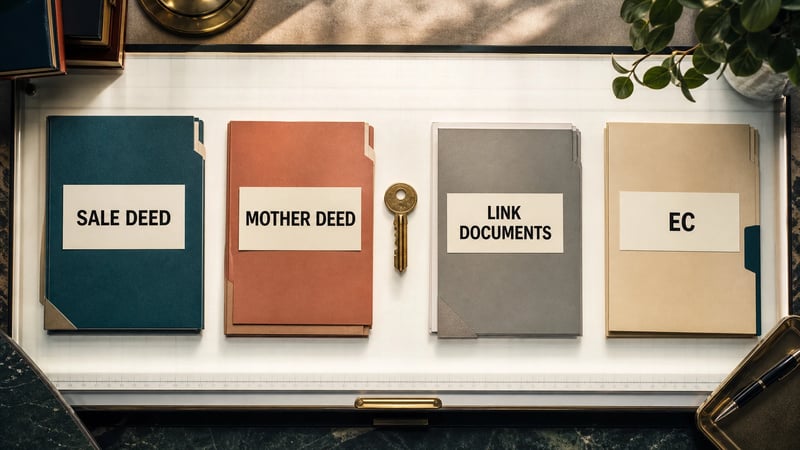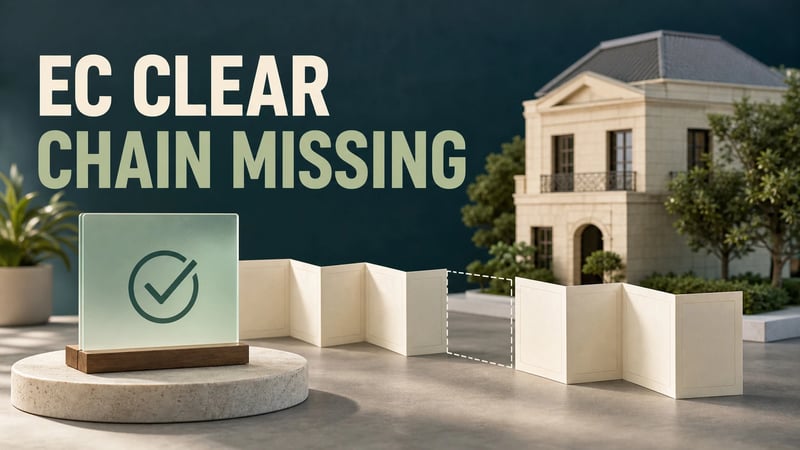
No. A clear encumbrance certificate can support the property file, but it does not automatically replace missing link documents or prove the full title is clear.
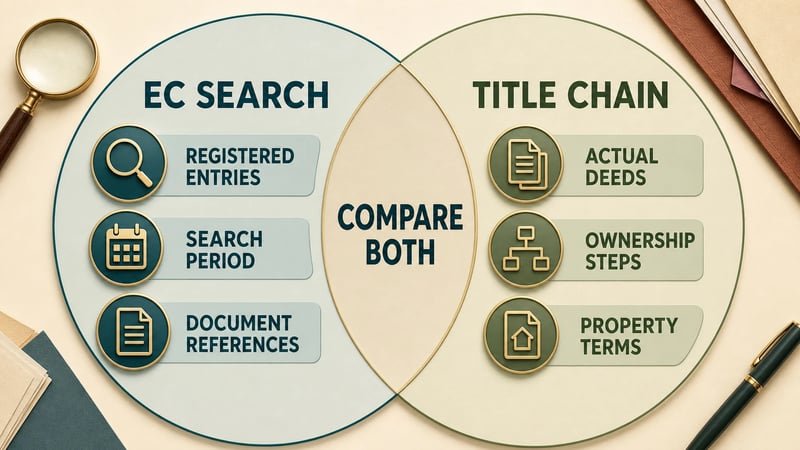
The EC tells you about registered entries returned for the property details and period searched. The link documents contain the actual instruments connecting one owner to the next.
Key takeaways
>
– A clear or nil EC is not the same thing as a complete title chain. – The search may help trace an old deed number, but it does not reproduce the deed. – Search particulars and the period matter. – Missing originals, missing registered deeds and missing ownership steps need different responses. – The lender may still ask for earlier deeds, certified copies, approvals or legal clarification.
If someone says, “The EC is clear, so no other paper is needed,” ask what happened to the missing ownership records.
What does a clear EC actually tell you?
An EC is obtained using specified property particulars and for a chosen period. It reports the registered transactions or charges returned by that search.
Depending on the registration record, it can show clues such as:
- sale or gift entries
- registered mortgages
- release or cancellation entries
- document number and year
- names of parties
- nature of the registered instrument
When no relevant encumbrance entry appears in the searched period, people may describe the result as clear or nil.
That is useful. It is not a complete legal conclusion about the property.
The result is only as good as the property details and period used for the search. An incorrect survey number, subdivision, flat number, house number or time range can leave out the record you expected to see.
What do link documents tell you?
Link documents contain the ownership instruments themselves.
They may show:
- how the previous owner acquired the property
- which rights were transferred
- the property description and boundaries
- conditions or reservations in the transfer
- whether a gift, partition, release or allotment occurred
- which parties signed the instrument
- references to still earlier title records
An EC entry may say that a sale deed was registered. The sale deed contains the detailed terms and property description that the summary entry does not.
This is why lenders can ask for the previous chain of property documents even when an EC is available.
What the EC and link documents answer
| Question | EC may help | Link documents may help |
|---|---|---|
| Was a registered transaction returned in the search? | Yes | The deed confirms its full terms |
| What document number should I look for? | Often | Later deeds may also refer to it |
| How did ownership move? | Gives a record trail | Shows the actual transfer instrument |
| What exact property was described? | Limited indexed details | Full schedule, area and boundaries |
| Are all building approvals present? | No | Usually separate approval records are needed |
| Is the title legally safe? | No standalone conclusion | Requires full due diligence, not one deed |
The two sources should be compared. They do not compete for the title of “best document.”
Check the EC search particulars before trusting the result
Keep the application or search details used to obtain the EC. Then compare them with the latest deed.
| Search detail | What to verify |
|---|---|
| Survey and subdivision | Matches the current deed and relevant older description |
| Plot, house or flat number | Identifies the intended unit, not only the larger land parcel |
| Village, ward and SRO | Matches the property’s registration history |
| Search period | Reaches the relevant earlier ownership and mortgage events |
| Owner or party references | Spelling differences are understood rather than ignored |
If the property came from a larger parcel, the old documents may use a parent survey number or different municipal description. Do not change the search yourself based on guesswork. Ask the registration authority or qualified local professional how the earlier and current descriptions connect.
A clear result under the wrong particulars gives false comfort.
Four reasons the EC can look clear while the chain is incomplete
1. The missing deed is older than the period searched
If the search covers only a recent period, an earlier transfer may not appear in the result you reviewed.
Ask which period was requested and why it is appropriate for the property history.
2. The search details do not match the old record
Survey subdivisions, municipal numbers and flat descriptions can change. A search under the present description may not automatically return every older indexed entry.
A local document professional or lawyer may need to trace the earlier particulars.
3. The registered entry exists, but the original deed is missing
The EC may show the transaction and document number. The seller still cannot produce the actual instrument.
This can create an original-document or evidence query for the lender. A certified copy may help, subject to the file and lender acceptance.
4. The claimed ownership event was not captured by the search
Inheritance, possession, family arrangements, court matters or other facts may require records outside the EC result. The exact legal effect depends on the case.
Do not assume a quiet EC means no other claim or title issue can exist.
Use a clear EC to investigate the missing link
The EC can be a starting point.
- Mark every transaction shown.
- Match each entry to a physical deed in the file.
- Note the document number, year and parties for any missing deed.
- Compare property descriptions across entries.
- Identify mortgages and corresponding releases.
- Extend or correct the search where the title history requires it.
- Request registered-document details or a certified copy from the official state source where available.
For Telangana, the official Bhu Bharati page lists Encumbrance Fetch, Registered Document Details and Certified Copy of Document as separate services.
That separation is useful. The EC helps find the trail. The certified copy can provide the registered document’s contents. Neither automatically decides lender acceptance.
A practical example
Suppose a seller bought a flat in 2016. The seller’s deed refers to a 2004 sale of the underlying land.
The buyer obtains an EC for 2011 to 2026. It shows the 2016 flat sale and no current mortgage. The result looks clear.
But the 2004 land sale falls outside that search period, and the corresponding deed is not in the builder or seller file.
The EC did not contradict the missing deed. It simply did not answer the older part of the title story.
The next step is not declaring the property safe. It is tracing and reviewing the 2004 record and the development chain.
What might the bank do?
The lender’s lawyer may:
- ask for the missing original
- accept a certified copy for review
- request a longer or corrected EC
- seek an earlier title-search report
- ask for the development or authority documents
- keep legal clearance conditional
- reject the property under legal or policy standards
Different lenders can reach different decisions. Their policies, legal panels and risk thresholds are not identical.
One bank’s approval also does not guarantee that another lender will accept the property when you sell later.
That future resale question matters. A document shortcut that passes today may become your buyer’s loan delay later.
Does the EC prove there is no mortgage?
An EC can help identify registered mortgage or charge entries returned in the search. But check:
- the correct property was searched
- the period covers the relevant loan
- a release or cancellation appears where expected
- the original documents are not still held by a lender
- the seller provides loan closure and no-dues evidence where applicable
A missing entry and a legally absent mortgage are not phrases to treat as identical without review.
If the seller has an active loan, coordinate with that lender and your proposed lender. Do not rely only on a printed EC.
Red flags despite a clear EC
Pause when:
- the seller refuses to produce the title chain
- a deed mentioned in a later document is absent
- names, survey numbers or areas do not align
- the search period is shorter than the known property history without explanation
- an older mortgage appears without a corresponding release
- one owner, co-owner or heir is missing from the transaction
- the builder’s land documents are unavailable
- the bank’s lawyer raises a title issue but the broker dismisses it
The seller may have a valid explanation. Ask for it in documents, not only words.
A safer home-loan sequence
- Obtain the latest deed and complete available chain.
- Review the EC for the correct details and period.
- Build a date-by-date title table.
- Match each EC entry to an instrument.
- Recover certified copies where available.
- Check approvals, dues and property description separately.
- Give the full file to the lender for legal and technical review.
- Obtain an independent qualified local property lawyer’s title opinion.
- Pay a large token only under reviewed written terms.
Borrower eligibility is another track. Strong income may support the loan amount, but it cannot fill a missing ownership step.
Bottom line
A clear EC is good information. It is not a substitute for missing link documents.
Use it to trace registered entries, identify old document numbers and compare the record with the physical title chain. If the chain still breaks, ask the lender exactly what its legal team needs and get an independent local property-law review before committing money.
For the borrowing side, browse Paisaseed’s Loans & EMI Planning guides.
This article is educational and not legal, lending or property-purchase advice. EC coverage, title documents, portal records and lender requirements vary by state, property and transaction. Verify official records and obtain advice from a qualified local property lawyer and proposed lender.
FAQs
Does a nil EC mean there are no property problems?
No. It means the search did not return the relevant registered encumbrance entries for the supplied particulars and period. It does not validate every deed, approval, ownership claim or property condition.
Can a bank approve a property with a clear EC but no old deeds?
It depends on why the old deeds are absent, the supporting title records and lender policy. The bank may ask for certified copies, other origin records or further legal clarification.
Can the EC help find a missing sale deed?
Often it can provide clues such as document number, year and parties. Use those details to ask the registration authority about the registered record and certified-copy availability.
Is a longer EC always enough?
No. A longer period can show more registered history, but it still does not replace the underlying instruments or a full title and approval review.
Should I trust a property because another bank financed it?
Existing finance is one data point. It does not remove the need to review your seller’s current title, documents, approvals, charges and the exact transaction you are entering.