If an old registered sale deed or link document is missing in Telangana, start by identifying its document number, year and Sub-Registrar Office. Then check the official Bhu Bharati route for registered-document details, EC and Certified Copy of Document services.
If the record is not available through the online service, contact the relevant SRO for the current manual process.
Key takeaways
>
– A certified copy is useful only after the correct registered document is identified. – The latest deed and EC can help you trace an older document number. – Use the official Telangana source, not a lookalike registration website. – Check names, survey numbers, area and boundaries after receiving the copy. – A certified copy does not guarantee that the lender will accept a missing original.
The goal is not merely to download a PDF. It is to recover the right record and reconnect the property’s title chain.
What is a certified copy of a property document?
A certified copy is an official copy issued from the registration record of a registered instrument.
It may reproduce a sale deed, gift deed, partition deed, release deed, mortgage or another registered document available in the authority’s records.
It is different from:
- an ordinary photocopy supplied by the seller
- a phone scan of an old deed
- a broker’s typed summary
- the encumbrance certificate
- a newly created “duplicate original”
Use the precise term certified copy when speaking to the registration office, lawyer or lender.
When is a certified copy useful?
It can help when:
- an old original deed was lost
- the seller never received the earlier original
- a later deed refers to an older registered instrument
- the EC shows a transaction missing from the physical file
- the lender’s lawyer asks to review the contents of an earlier deed
- names or property descriptions need comparison
It cannot create a deed that was never registered. It also cannot by itself resolve an unaccounted heir, ownership dispute, approval issue or mismatch in the chain.
Collect these details before opening the portal
The stronger your identifiers, the lower the chance of retrieving the wrong record.
Try to collect:
| Detail | Where you may find it |
|---|---|
| Document number | Later sale deed, EC, old photocopy or registration reference |
| Registration year | Document reference or EC |
| Sub-Registrar Office | Registration endorsement or later deed |
| Document type | Sale, gift, partition, release, mortgage or other instrument |
| Executant and claimant names | EC or deed reference |
| Survey and subdivision number | Current and earlier property schedule |
| Plot, flat or house number | Current deed and municipal records |
| Area and boundaries | Property schedule |
Do not guess a document number from a handwritten note without cross-checking it.
One digit can lead to another person’s property record.
Find the old document reference
Start with the documents already available.
Read the current sale deed
Look for phrases referring to the seller’s acquisition, a prior registered document, book number, document number, year or SRO.
Review the EC
An EC may show registered entries for the searched property details and period. Use it to identify transaction dates, parties and document numbers.
Check that the property details and period are appropriate. An old deed may sit outside the range you searched.
Ask for the seller’s old loan-document list
If a lender once held the originals, the seller may have a list of title documents deposited with that bank. That list can reveal the missing instrument’s description.
Check authority, builder or society records
In a plotted layout or apartment, an allotment file, development record or association document may refer to the relevant title deed.
These are tracing clues. Verify the final reference against official registration records.
The six-step recovery path
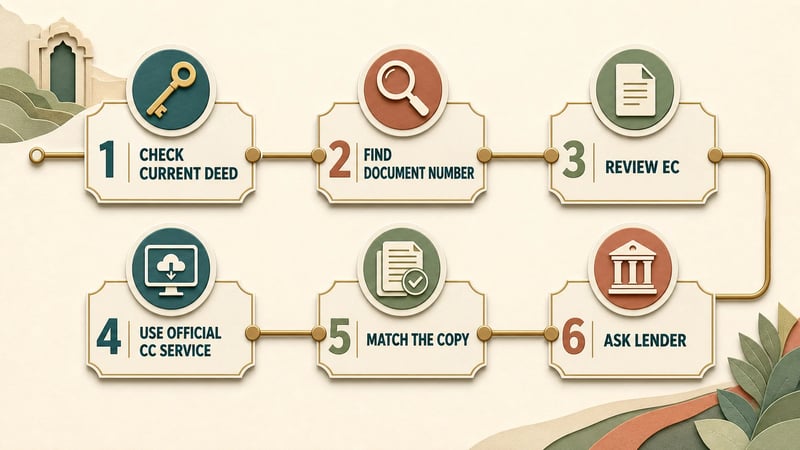
Step 1: Write the exact gap
Use one sentence:
“The current deed refers to document 1234 of 2009 at SRO X, but that deed is not in the seller’s file.”
Avoid the vague phrase “all old links missing.”
Step 2: Cross-check the identifiers
Confirm the number, year, SRO, parties and property details from at least one reliable record. When possible, compare the deed reference with the EC.
Step 3: Start from the official Telangana source
The Bhu Bharati information page currently lists:
- Registered Document Details
- Encumbrance Fetch (EC)
- Certified Copy of Document (CC)
Portal menus, authentication, charges and delivery options can change. Follow the current instructions on the official site.
Step 4: Use the SRO route when necessary
Older, unavailable or difficult-to-locate records may require help from the relevant Sub-Registrar Office.
Ask what application, identity proof, property details, fee and collection method currently apply. Do not rely on an old blog screenshot for today’s process.
Step 5: Verify the received copy
Check that it is the document you requested:
- correct document number and year
- correct SRO
- correct parties
- correct document type
- complete page sequence
- readable property schedule
- certification or issuance details appropriate to the service
Do not forward it to the bank before checking the property description.
Step 6: Rebuild the chain
Place the certified copy between the deed before it and the deed after it.
Does the transferee in the recovered document become the transferor or title holder in the next step? Do survey number, area and boundaries connect?
The copy is valuable only if it helps explain the chain.
What if you do not know the document number?
Do not search randomly.
Build a title timeline from:
- latest available deed
- EC entries
- seller’s old copies
- lender document lists
- authority or builder references
- tax and municipal records used only as clues
Then ask a qualified local property lawyer or document professional to help identify the relevant registration record.
If the ownership event itself is unknown, the issue is no longer only “how to get a copy.” The title history needs investigation.
Can the certified copy be used for a home loan?
It can be submitted for review. Do not assume acceptance.
Ask the lender:
- Is the legal query about the contents of the old deed or the absence of the original?
- Will a certified copy be reviewed?
- Is any loss report, public notice, indemnity or other evidence required for this case?
- Does the lender need a longer EC or title-search report?
- Will the legal clearance remain conditional?
The lender’s response can vary by document age, property history, mortgage requirements and internal policy.
A lender may accept the copy for one purpose but still require another condition before disbursement.
Check the certified copy against the property file
Use a comparison table.
| Field | Certified copy | Later deed | Current property |
|---|---|---|---|
| Owner names | |||
| Survey and subdivision | |||
| Plot or flat number | |||
| Area | |||
| Boundaries | |||
| Undivided share | |||
| Prior document reference |
Mark every difference.
A spelling variation may have a straightforward explanation. A change in survey number, area, boundary or ownership share can need deeper review.
Do not edit the scanned copy or cover a mismatch before sending it to the lawyer or lender.
Protect yourself from lookalike sites and agents
Property-document searches expose names, addresses and transaction details.
Use basic care:
- begin from the official Telangana page
- check the domain before entering mobile or identity details
- do not send Aadhaar or OTP to an unknown document agent
- do not pay a “guaranteed bank approval” fee
- save the official payment receipt
- keep the unedited downloaded or collected file
- redact personal data before sharing publicly
An agent may assist with process. The record should still come from the official authority.
What the certified copy cannot fix
It does not automatically resolve:
- an unregistered or unexplained ownership event
- a missing heir or co-owner
- a forged or disputed transaction
- a property-description mismatch
- an unresolved mortgage
- an unauthorised layout or building deviation
- missing occupancy or other required approval
- lender policy restrictions
Do not turn a document-recovery success into a full property-safety conclusion.
Prepare one clean lender package
After recovery, submit the relevant file together:
- current seller’s title deed
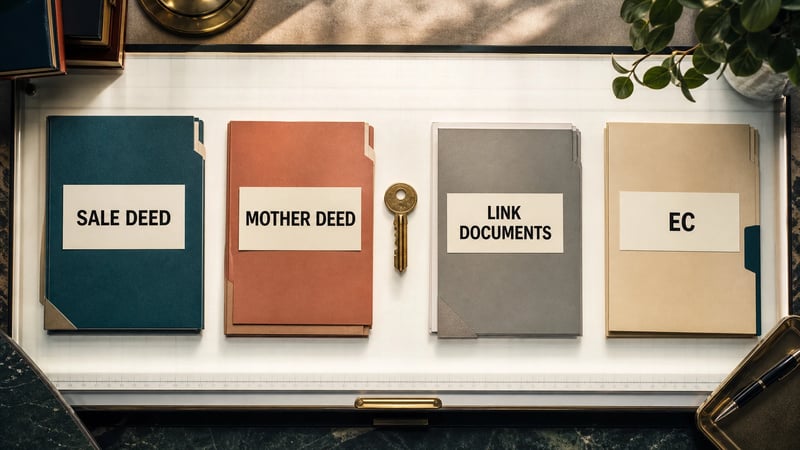
- earlier link documents in date order
- certified copy clearly labelled
- EC used to trace the record
- one-page title-chain table
- written explanation of the missing original
- approvals and dues documents
- any lender-specific form or clarification
This is easier for legal review than sending documents one by one across several chats.
Keep a complete copy and obtain an acknowledgement when originals are later deposited.
Bottom line
To get an old sale deed or link-document certified copy in Telangana, first identify the exact registered instrument. Use the current deed and EC to find the document number, year and SRO, then use the official Bhu Bharati certified-copy route or contact the relevant SRO.
After receiving the copy, verify every property and party detail and ask the lender whether it addresses the legal query. Record retrieval is an important step, not a guarantee of title or home-loan approval.
For broader borrowing help, use Paisaseed’s Loans & EMI Planning guides.
This article is educational and not legal, registration, lending or property-purchase advice. Telangana portal menus, charges, record availability and lender requirements can change. Verify the current official process and obtain advice from a qualified local property lawyer and proposed lender.
FAQs
Where can I get a certified copy of a sale deed in Telangana?
Start from the official Bhu Bharati information page, which lists Certified Copy of Document, Registered Document Details and EC services. If the record is unavailable online, ask the relevant Sub-Registrar Office for the current process.
Can I get an old sale deed without the document number?
You may first need to trace the number through the current deed, EC, an old copy, authority record or lender’s document list. The SRO or a qualified local professional can advise on the current search process.
Is a certified copy the same as the original sale deed?
No. It is an official copy from the registered record. Whether it satisfies a lender’s concern about a missing original depends on the property and lender policy.
Can I use a certified link deed for home-loan legal verification?
You can submit it for review. Ask the lender in writing whether the certified copy addresses its specific query and whether any other loss or title documentation is required.
How do I know the certified copy belongs to my property?
Match the document number, year, SRO, parties, survey number, plot or flat number, area and boundaries with the later deeds and current property description.