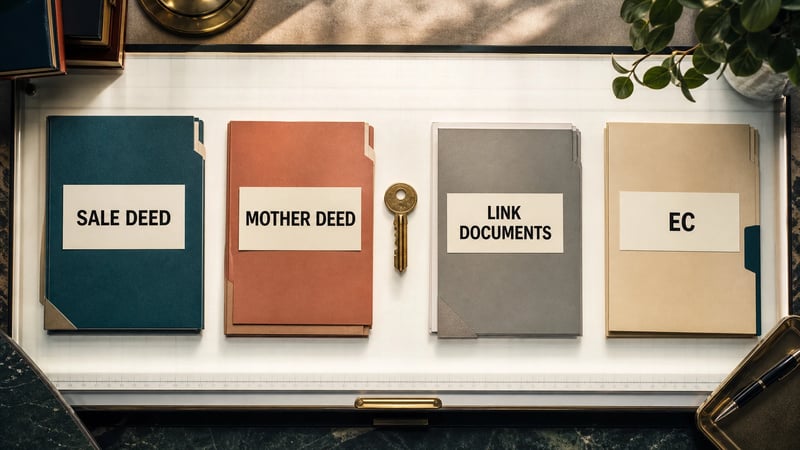
Not automatically. One missing link document can lead to a request for more records, a conditional clearance, a delay or a rejection.
The outcome depends on what is missing. A lost original of an identifiable registered deed is different from an ownership transfer that cannot be proved at all.
Key takeaways
>
– First identify whether the paper is missing or the ownership step is missing. – An EC or later deed may help you trace the old document number. – A certified copy can support the file, but lender acceptance is not automatic. – Do not assume an affidavit repairs a title gap. – Pause payment when names, property details, owners or transfer history do not connect.
This is a property-file question, not an EMI question. A borrower can be financially eligible and still face a legal-document query.
Three different problems can look like one missing document
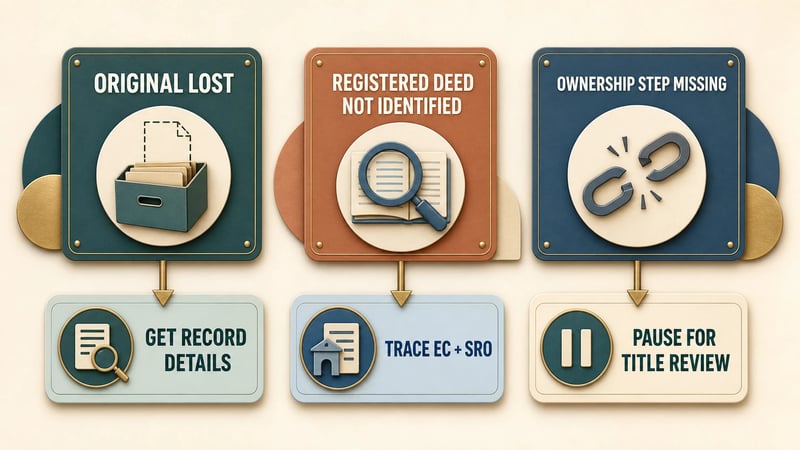
When a seller says “one old link is missing,” ask which of these they mean.
1. The original paper is unavailable
The earlier deed was registered, its details are known and a copy may exist, but the physical original cannot be produced.
This is mainly a custody and evidence problem. It still matters because the lender may expect originals or a specific explanation before taking the property as security.
2. The deed was registered, but nobody can identify it
A later document refers vaguely to an older transfer, or the seller believes a deed exists but does not know the document number, year or Sub-Registrar Office.
The first job is tracing the record, not debating whether a photocopy will be accepted.
3. The ownership event itself is unsupported
The chain jumps from Owner A to Owner C, with no document explaining Owner B’s rights or transfer. Or one heir, co-owner, gift, partition or development arrangement is asserted without the relevant record.
This is the most serious category. A certified copy helps only if an actual registered instrument exists and can be identified.
Why can one old link matter to a bank?
The lender wants to understand whether it can create a valid mortgage over the property under its policy.
A gap can raise questions about:
- how an earlier owner obtained rights
- whether the current seller’s title connects
- whether another owner or heir could be missing
- whether the property description changed
- whether an older mortgage or charge was cleared
- whether the original file is already deposited elsewhere
- whether the property can be sold later if the loan defaults
Current resale-home checklists can ask for title deeds including the previous chain of property documents. The lender’s lawyer can seek more after studying the specific file.
This does not mean every missing old original causes rejection. It means the gap must be identified and assessed.
Start with the latest deed and work backwards
Read the current seller’s deed for references to:
- the previous deed number and date
- the previous owner’s name
- the Sub-Registrar Office
- survey and subdivision number
- property boundaries
- flat or plot number
- undivided share of land
- how the seller obtained title
Then read the previous available deed.
Repeat until you reach the origin record or the point where the chain breaks. Write the break as one sentence:
“The 2018 sale deed says the seller bought from Owner B, but Owner B’s 2007 acquisition deed is not in the file.”
That is far more useful than saying “link document missing.”
Use the EC as a tracing tool
An EC may show registered transactions or charges returned for the searched property details and period.
It can help you find:
- document number
- registration year
- parties to a transaction
- nature of the registered instrument
- mortgage or release entries
Compare the EC with the physical chain.
| EC result | File result | Question |
|---|---|---|
| Old sale shown | Deed missing | Can an official certified copy be obtained? |
| Mortgage shown | Release not found | Was the charge closed and recorded? |
| Deed shown under different details | Chain uses another number or area | Was the search or document description wrong? |
| No matching transaction | Seller claims an old sale | Which particulars and period were searched? |
Do not treat a clear result as proof that the missing instrument never existed. Confirm the search inputs and period.
Can you get a certified copy?
If the instrument was registered and can be identified, ask the relevant registration authority about its current certified-copy process.
For Telangana records, the official Bhu Bharati information page lists:
- Registered Document Details
- Encumbrance Fetch
- Certified Copy of Document
Other states have their own registration portals and Sub-Registrar processes.
A certified copy is an official copy of the registered record. It is not the same thing as the original paper once held by the parties.
Before spending money or time, ask the lender:
- Will you review a certified copy for this document?
- Do you also require a loss explanation or other evidence?
- Is the issue the absent original or a title-chain concern?
- Will legal clearance remain conditional?
- Which exact record would satisfy the query?
Get the answer in writing where possible.
Do an affidavit or newspaper notice solve it?
Do not assume so.
Depending on the facts and local legal advice, steps such as a police complaint, public notice, indemnity or affidavit may be discussed when an original is lost.
But these steps do not create a transaction that never happened. They also do not automatically bind a lender to accept the file.
The order matters:
- Identify the missing record.
- Understand why it matters.
- Ask the lender what its legal query is.
- Obtain independent property-law advice.
- Follow only the case-specific recovery steps advised.
Starting with a generic affidavit can produce more paper without solving the actual question.
Check whether the rest of the chain still connects
One recovered deed is useful only if its details align.
Compare:
- transferor and transferee names
- document dates and references
- survey and subdivision numbers
- plot, flat or house number
- area, boundaries and undivided share
- co-owner and heir details
- registration office and jurisdiction
If an older deed describes 240 square yards and the later deed suddenly describes 300 square yards, the missing-paper discussion is not enough. The area change needs its own explanation.
The same applies when an owner’s initials, family relationship or share changes across the file.
What outcomes can the lender give?
The bank may:
- ask for a certified copy
- seek more prior documents
- request a written legal clarification
- hold legal clearance pending another record
- reduce or change the property-related approval
- reject the property under legal or policy criteria
Another lender may take a different view. That does not mean the first bank was wrong or the second one has certified the title for you.
Understand the property issue before applying repeatedly.
Paisaseed’s loan-eligibility calculator can help with the borrower’s income side. It cannot estimate whether a lender’s lawyer will accept a missing original or certified copy.
When should the buyer stop and reconsider?
Pause if:
- the seller will not let you see the complete chain
- the missing deed cannot be identified
- the EC and available documents tell different stories
- a co-owner or heir is unaccounted for
- property area, boundaries or survey numbers do not match
- the seller demands a large non-refundable payment first
- the suggested solution is only a broker’s verbal assurance
- the bank refuses legal clearance but nobody explains the underlying issue
Stopping is not an accusation. It is a decision to avoid turning an unresolved title question into your financial problem.
A clean recovery checklist
Use this sequence:
- List every available title document in date order.
- Write exactly where the chain breaks.
- Extract the missing document reference from later deeds.
- Compare the EC with the file.
- Obtain registered-document details from the official state source.
- Request a certified copy if the record is identifiable and available.
- Give the full file to the proposed lender, not one page at a time.
- Ask for the remaining legal query in writing.
- Obtain an independent qualified local property lawyer’s review.
- Commit money only under reviewed written terms.
Keep copies of every document supplied to the lender and a detailed acknowledgement if originals are handed over.
Bottom line
One missing link document does not produce one automatic home-loan result. The bank’s response depends on whether the issue is a lost original, an untraced registered deed or a genuinely unsupported ownership step.
Trace the record, compare the full chain and ask the lender what its lawyer needs. If the chain itself does not connect, pause and get independent local property-law advice before paying or registering.
For broader borrowing guidance, use Paisaseed’s Loans & EMI Planning guides.
This article is educational and not legal, lending or property-purchase advice. Document recovery, title requirements and lender acceptance differ by state, property and transaction. Verify official records and obtain advice from a qualified local property lawyer and proposed lender.
FAQs
Will every bank reject a property if one link deed is missing?
No universal rule applies. A lender may ask for a certified copy or more evidence, keep clearance pending or reject the property depending on the document, title history and internal policy.
Is a certified copy accepted for a home loan?
It may be reviewed, but acceptance is not automatic. Ask whether the lender’s concern is the lost original, the registered instrument’s contents or a larger title-chain gap.
Does a police complaint make a lost sale deed valid for a bank?
A complaint can document reported loss where applicable, but it does not replace the deed or guarantee lender acceptance. Follow case-specific advice from the lender and a qualified property lawyer.
Can a clean EC solve one missing link document?
No. It may help identify the registered transaction, but it does not reproduce the complete instrument or resolve every title issue.
Should I try another bank after a document rejection?
First understand why the property failed. Another lender’s policy may differ, but a genuine ownership or approval problem remains even if another bank is willing to lend.