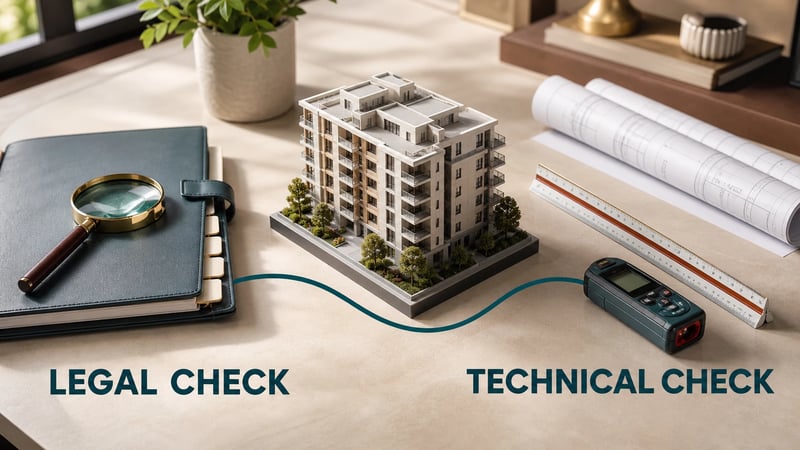
The lender can approve your income and still keep the property pending.
During legal verification, the bank reviews title and property documents to decide whether it can accept the property as security. During technical verification, it may inspect the property, compare it with plans, review construction and assess value.
Key takeaways
>
– Borrower approval and property approval are separate. – Legal review focuses on title, ownership, encumbrances, authority and mortgageability. – Technical review focuses on the physical property, plan, construction stage and valuation. – A sanction letter can contain conditions pending property clearance. – Bank verification protects the lender’s loan decision; it does not replace the buyer’s independent due diligence.
Ask which stage is pending before you hear “verification” and assume the whole loan is stuck.
One home loan, five different decisions
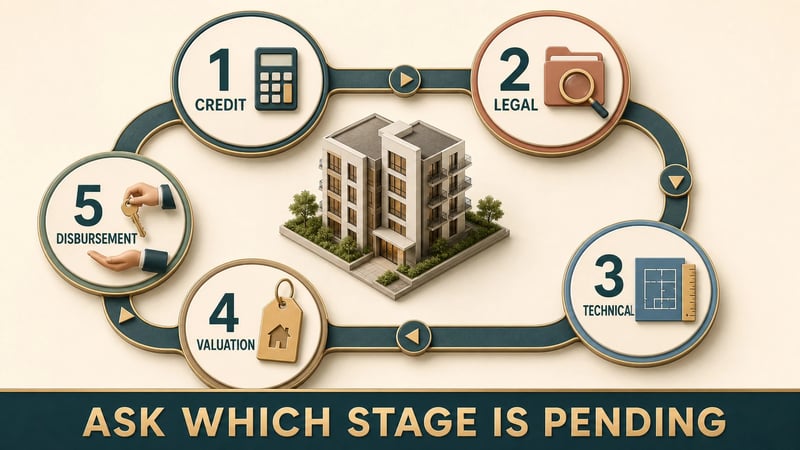
What borrowers call “approval” can contain five assessments.
| Stage | Main question |
|---|---|
| Credit | Can the borrower reasonably repay under the lender’s policy? |
| Legal | Does the title and document file support the lender’s mortgage? |
| Technical | Does the physical property broadly match the documents and applicable plan information reviewed? |
| Valuation | What value will the lender recognise for loan purposes? |
| Disbursement | Have the conditions, contribution and original-document requirements been met? |
These stages can overlap. Their results can also differ.
A borrower may have a strong salary and credit profile while the property has a title gap. A property may have a good document file but receive a lower lender valuation than the agreed price.
What happens during credit assessment?
This is the borrower side.
The lender may review:
- KYC
- salary slips or business income records
- bank statements
- Form 16 or ITRs
- existing EMIs
- credit report and repayment history
- co-applicant income
- down-payment or own-contribution evidence
Paisaseed’s loan-eligibility calculator can give a planning estimate based on income and obligations. It does not reproduce a bank’s underwriting model.
More importantly, it says nothing about the property’s title or approvals.
What does the bank’s legal team check?
The legal review is property-specific.
The panel lawyer may examine:
- current title deed
- previous title or link documents
- how the seller acquired rights
- names of owners and authorised signatories
- co-owner, heir, gift or partition records where relevant
- EC and registered charges
- existing mortgage and release documents
- agreement to sell
- sanctioned plans and statutory approvals
- development agreement and power of attorney where relevant
- property-description consistency
- whether the lender can create the security it requires
The list changes by property type.
A direct builder flat, resale apartment, independent house, authority-allotted plot and self-construction loan will not have identical legal files.
The lender may ask for additional documents after the first review. Public checklists are usually indicative.
What title-chain issues can delay legal clearance?
Common questions include:
- one link deed is missing
- the latest deed refers to an older document not in the file
- owner names differ across records
- survey number, area or boundaries change
- one co-owner or heir is unaccounted for
- an old mortgage appears without a release
- the seller’s originals are held by another lender
- development authority is unclear
- the property is under litigation or another recorded restriction
A query is not automatically a rejection. The lender may ask for a certified copy, clarification or another supporting record.
But do not treat every query as a paperwork formality. First understand whether it concerns missing evidence or the title itself.
What happens during technical verification?
The technical team or valuer may inspect the site and compare the property with the documents and plans available to it.
The review can consider:
- property location and access
- plot or unit identity
- building type and age
- construction stage
- built-up area or other measurements used by the lender
- apparent comparison with the sanctioned plan
- visible deviations or additions
- condition and marketability
- surrounding development
- estimated market value for lending purposes
For under-construction property, the lender may also connect disbursement to construction progress.
Technical clearance is not a structural safety certificate or engineering warranty for the buyer. If you need a detailed condition or structural assessment, use an appropriate independent professional.
Why can the bank’s valuation be lower than the sale price?
The seller and buyer agree a transaction price. The lender makes its own valuation under its process.
The two can differ because of:
- local comparable values
- property condition and age
- approved versus observed area
- location or access
- construction stage
- lender policy
- distress, premium or furnishing amounts built into the negotiated price
Suppose you agree to pay Rs 80 lakh, but the lender recognises Rs 70 lakh for its loan calculation. The lender may calculate its permitted loan against the lower recognised value and its applicable loan-to-value policy.
That can increase the cash you need.
Do not assume the sanction amount based on your income will be fully disbursed against any property price.
Use the home-loan EMI calculator for repayment planning, then keep registration, legal review, repairs and any valuation gap outside the EMI calculation.
Sanction letter does not always mean money is ready
Read the sanction letter for:
- validity period
- sanctioned amount
- interest-rate terms
- tenure and EMI
- own-contribution requirement
- legal and technical clearance conditions
- special conditions before disbursement
- original-document requirements
- property and seller conditions
Ask the lender:
- Has borrower credit approval finished?
- Has property legal clearance finished?
- Has technical inspection finished?
- Has valuation been approved?
- Are any special conditions open?
- Which originals are required?
- What must happen at registration and disbursement?
A verbal “everything is approved” is less useful than a written list of pending conditions.
What happens if the legal review finds a problem?
Possible outcomes include:
| Finding | Possible lender response |
|---|---|
| Missing identifiable deed | Ask for original, certified copy or clarification |
| Name or property mismatch | Seek correction or supporting evidence |
| Existing mortgage | Require closure and coordinated original release |
| Unclear ownership or authority | Keep pending or reject |
| Missing approval | Seek the relevant approval or reject under policy |
| Property type outside policy | Reject even if title documents are otherwise available |
The lender may not give you its full internal legal opinion. Ask for the practical reason and exact pending document.
Then obtain an independent lawyer’s advice before attempting a correction or changing lenders.
What happens if the technical review finds a problem?
The bank may:
- ask for plan or area clarification
- value the property lower
- restrict the eligible amount
- hold disbursement until a construction milestone
- reject unauthorised or policy-ineligible property
- seek updated approval or completion records
Do not ask the seller to hide a modification before inspection. Understand whether it is authorised and how it affects the transaction.
Bank legal verification is not your legal verification
The lender’s review asks whether it can lend and create its mortgage under its standards.
Your lawyer should ask buyer-focused questions:
- Are you receiving the rights you think you are buying?
- Are the seller and all required parties properly included?
- Do the agreement and payment terms protect you?
- Does the title chain and property description support your purchase?
- Are any restrictions, approvals or disputes relevant to your use and resale?
The bank and buyer share some concerns, but they do not have identical duties or risk.
Another bank’s earlier approval is not a substitute for the current file.
How to prepare one clean verification package
- Make a document index.
- Arrange title documents by date.
- Add EC and existing-mortgage records.
- Add agreement, receipts and seller KYC.
- Add approved plan, OC or CC and authority papers where applicable.
- Add tax, association and no-dues records.
- Label originals, certified copies and ordinary copies.
- List every known mismatch.
- Submit the complete package together.
- Keep copies and obtain an acknowledgement for originals.
Sending the file in fragments can create repeated queries and unclear status.
How long does legal and technical verification take?
There is no reliable universal number.
Time depends on:
- lender process
- property type
- document completeness
- local record access
- inspection scheduling
- legal query complexity
- seller and builder response
Ask for the pending item and next action instead of relying on a generic “three to seven days” claim.
If nothing moves, request a written status and escalation route from the lender.
Bottom line
Home-loan legal verification checks whether the property file can support the lender’s mortgage. Technical verification checks the physical property, plan, construction and valuation under the lender’s process.
Treat credit sanction, property clearance and disbursement as separate stages. Ask which one is pending, provide one organised file and obtain your own qualified legal and technical advice for the purchase.
For more borrowing help, use Paisaseed’s Loans & EMI Planning guides.
This article is educational and not legal, technical, valuation, lending or property-purchase advice. Lender checks, title requirements and property standards vary. Verify current requirements with the proposed lender and use qualified independent professionals for your transaction.
FAQs
Can a home loan be sanctioned before legal verification?
A lender may assess the borrower and issue a conditional sanction while property checks remain pending. Read the sanction conditions and ask whether legal, technical and valuation clearance has finished.
Does the bank’s lawyer visit the property?
The legal and technical functions are usually different. A technical valuer or representative may inspect the site, while the legal team reviews title and property documents.
Can a good CIBIL score overcome a property legal issue?
No. A credit score supports borrower assessment. The property must still meet the lender’s legal, technical, valuation and policy requirements.
Does technical approval mean the construction is fully safe?
No. It is the lender’s technical assessment for lending. It should not be treated as a complete structural or condition warranty for the buyer.
Why did the bank value my property below the sale price?
The lender uses its own valuation process and may exclude negotiated premiums, furnishing or unauthorised area. A lower recognised value can reduce the loan amount and increase the buyer’s cash requirement.